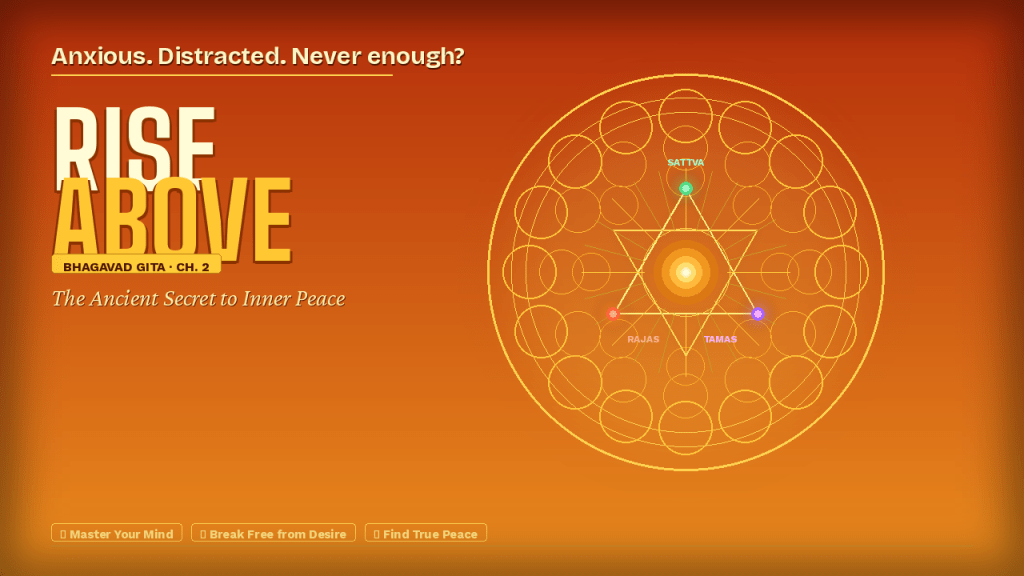
Rise Above the Three Gunas: Lessons from the Bhagavad Gita for Modern Life
A reflection on applying ancient wisdom to everyday living
The Shloka
त्रैगुण्यविषया वेदा निस्त्रैगुण्यो भवार्जुन। निर्द्वन्द्वो नित्यसत्त्वस्थो निर्योगक्षेम आत्मवान्॥
Translation: “The Vedas deal with the subject of the three gunas (qualities of nature). O Arjuna, rise above the three gunas, be free from duality, ever established in purity (sattva), without the anxiety of acquiring and preserving, and be Self-realized.”
Understanding the Three Gunas
Lord Krishna reveals a profound truth in this verse: the entire creation every living being without exception is made up of three fundamental qualities, or gunas:
- Sattva — purity, clarity, and wisdom
- Rajas — passion, desire, and restless activity
- Tamas — inertia, ignorance, and darkness
Think of it like a vessel forged from three metals copper, iron, and aluminium. If you were to separate those three metals, the vessel itself would cease to exist. In the same way, every being in creation is a blend of these three gunas in varying proportions. This is not a man-made theory it is one of the divine laws (Ishwariya niyam) that our ancient seers discovered and documented, much like the laws of physics describe the natural world.
What Krishna Is Asking of Arjuna and of Us
Krishna’s instruction is clear: become Trigunatita one who transcends the three gunas. But what does that actually mean in practice?
1. Establish Yourself in Sattva
Of the three gunas, sattva is the subtlest and purest. Krishna urges Arjuna and through him, all of us to consciously move toward sattva and away from the dominance of rajas and tamas. To be nityasattvastho means to dwell permanently in a state of vivek (discernment) and inner peace.
This is not something that happens overnight. It requires satatam abhyas continuous, patient practice. Just as a new rider struggles to balance a motorbike at first, wobbling and nearly falling, with regular practice the same person can ride effortlessly. The same principle applies to cultivating sattva in our inner life.
2. Be Free from Duality (Nirdvandvo)
Life is full of pairs of opposites: pleasure and pain, gain and loss, heat and cold, praise and criticism. Most of us swing between these extremes, which creates endless mental agitation.
Krishna says: be nirdvandvo free from this duality. This doesn’t mean pretending that hardship doesn’t exist. It means developing samabhav an equanimity that can acknowledge both joy and sorrow without being destabilized by either. When we practise this evenness consistently, we gradually free ourselves from the inner conflict (dvandva) that keeps us trapped in suffering.
3. Release the Grip of Yoga-Kshema
This is a powerful and surprisingly modern teaching. Yoga-kshema refers to two deeply human tendencies:
Yoga (in this context) = the craving to acquire the dream car, the dream home, the dream business, the recognition and status we pursue endlessly. It is the rajasic pull of glitter and glamour, the voice that says, “If I just get that one thing, I’ll be happy.”
Kshema = the anxiety to preserve what we already have the constant worry about protecting our possessions, our reputation, our comfort zone.
Krishna says both of these keep us chained. The craving to get and the fear of losing are two faces of the same attachment. They are the root cause of human anxiety. Being free from yoga-kshema doesn’t mean abandoning ambition it means acting without being enslaved by outcomes.
4. Become Atmavan — Self-Realized
The final instruction: know your true self. We spend our lives identifying with labels Manager, CEO, President, Owner, Father, Successful Businessperson. These are anatma upadhi the costumes of maya, the illusory self draped over our true nature.
To be atmavan is to shed those costumes in awareness, to continually ask: “Who am I beneath all these roles? What is my pure, conscious self?” This is not a one-time realization but a continuous, alert practice a returning, again and again, to that deeper identity.
Karma Yoga: The Bridge
This shloka connects directly to the broader message of karma yoga that runs through the Gita. Krishna had already taught Arjuna: when you perform actions free from swarth (selfishness) and ahankar (ego), those actions become karma yoga the path that unites you with the divine.
The point is this: we can work hard, earn wealth, build businesses, and achieve great things. None of that is forbidden. The question is: what is the inner quality of that action? Is it driven by ego and craving or is it an offering, free from attachment to results?
When the ego is gradually dissolved through sustained practice of sattva, duality drops away, and the seeker naturally rises beyond the three gunas into the realm of pure awareness.
A Timeless Science
Our ancient rishis were not merely philosophers they were scientists of the inner world. They tested these principles, verified them through direct experience, and recorded their findings in the Vedas and shastras. Just as we trust a seasoned pilot who has mastered flight through thousands of hours of practice, we can trust the wisdom of those who mastered the inner science of consciousness.
Einstein’s famous equation E=mc² is often cited as modern genius. But the core insight that energy and matter are interchangeable, that the seen emerges from the unseen resonates deeply with Vedic understanding of reality. Our ancestors knew this. Much of what the modern world calls discovery is, in many ways, a rediscovery.
Key Takeaways for Daily Life
Practice equanimity. The next time you face loss, disappointment, or unexpected difficulty notice the pull to react. Can you find the still point beneath the reaction? That stillness is sattva.
Question your desires. Are you pursuing something because it genuinely serves your highest purpose, or because rajas is driving you to chase the next shiny thing? There is no judgment in the question only awareness.
Let go of over-attachment. What are you gripping too tightly your possessions, your identity, your image? Kshema (anxious preservation) is just as binding as craving. Both steal your peace.
Ask “Who am I?” Not as an abstract philosophical exercise, but as a living, daily inquiry. Each time you catch yourself over-identifying with a role or label, gently come back to the deeper question.
Keep practising. The Gita does not promise instant transformation. It promises that abhyas (practice), done sincerely and continuously, will bear fruit. The expert driver was once the nervous beginner. So were all the great sages.
Closing Reflection
The Bhagavad Gita is not a relic of the past. It is a living manual for navigating the complexities of modern life materialism, identity, anxiety, ambition, and the search for meaning. The three gunas are not ancient mythology; they are the very fabric of your psychology, playing out in every decision you make today.
Rise above them not by rejecting the world, but by changing your relationship to it.
Hare Krishna. Jai Shri Krishna.
This post is based on a live discourse on Bhagavad Gita Chapter 2, exploring the verse on transcending the three gunas (Trigunatita) and its application in daily life.

Leave a comment